About SODA
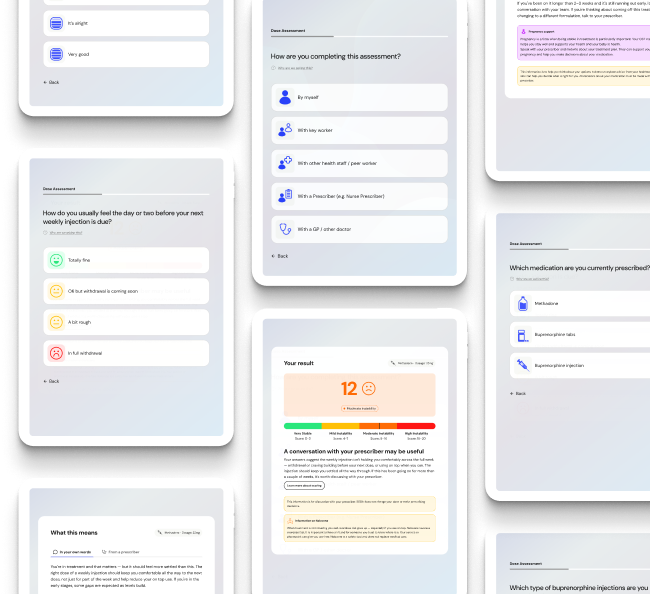
SODA (Stability of Opioid Dose Assessment) is a brief structured tool designed to help people in opioid treatment understand how well their medication is working and support better conversations with their care team.
How SODA works
SODA provides a structured summary of treatment experience to support reflection and discussion between patients and their care team. It does not provide recommendations or suggest dose changes — all decisions about your care stay with your prescriber or care team.
Complete: Takes about 5-10 minutes
Answer: Questions about withdrawal, craving, use and missed doses
Score: Divided up into 4 bands
See: Your experience of treatment and 'stability band'
Discuss: Share with your care team
What SODA Measures
How you feel before your dose
- •How well it gets rid of withdrawal symptoms
- •How well it holds you between doses
- •How you feel after your dose
Thinking about opioid use
- •Using on top
- •Effects from using on top
Whether you miss doses or take your medication differently.
- •Missed doses
Your answers are added together to give one score.
- •Higher score = more instability / possible gaps in your treatment
- •Lower score = more stable / possibly less gaps in your treatment
Designed to work for all OST medications
Methadone
Daily liquid or tablet. SODA asks whether your medication lasts through the day.
Oral Buprenorphine
Sublingual daily tablet or film. SODA asks whether your medication lasts through the day.
Weekly Depot
Buvidal weekly. SODA asks whether the injection lasts through the week.
Monthly Depot
Buvidal monthly. SODA asks whether the injection lasts through the month.
Evidence & Validation
Early testing
SODA v1 was piloted with over 1,000 patients across three community drug services in England. In early testing, most people said SODA made sense and reflected their treatment experience. We are still making improvements.
These early results do not mean SODA can diagnose problems or recommend treatment changes. They show that people understood it and found it relevant and useful.
80%+ Rated accuracy
More than 80% said SODA reflected their experience accurately.
67% Moderate–High instability
More than 60% had scores showing clear gaps in treatment stability.
92.6% Intend to Discuss
In the highest instability group, most people said they planned to talk to their prescriber.
Where SODA Works

Community Drug Services
Keyworker sessions, prescriber reviews, group settings.

Prison Healthcare
Browser-based via secure systems. Prison-specific question sets.

GP Shared Care
Satellite site model. No integration required.
Community Pharmacy
Completion at supervised consumption appointments.
Naloxone Matters
SODA includes naloxone information because noticing when treatment does not feel stable is only part of the picture — people also need simple, accessible ways to reduce immediate risk.
Why It Matters on OST
- Using opioids on top of OST can raise overdose risk, especially if your medication is not lasting long enough.
- Missing doses lowers your tolerance — your usual amount can have stronger effects
- At transition points like prison release, your tolerance may be lower than you realise
What to Do
- Ask your keyworker or prescriber for a free naloxone kit
- Keep it somewhere easy to find quickly
- Show someone you trust how to use it
- Check the expiry date occasionally — it is free to replace
Ready to get started?
Start your SODA check-in. It takes 5–10 minutes and gives you a simple score you can share at your next appointment.